|
LAMINATING WOOD
LAMINATING WOOD
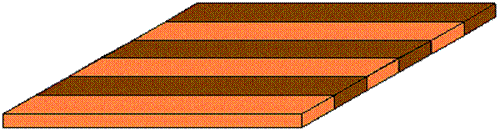
By using a method called laminating,
two or more strips of wood can be joined together to make one larger piece of
wood. Lamination is essentially the
gluing together of several strips of wood.
It is important that the surfaces of the strips be squared off so that
we get a straight board.
FACTS ABOUT LAMINATION
- You
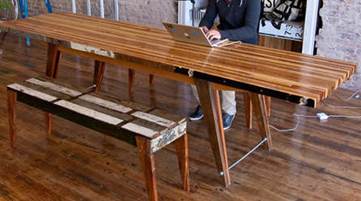
can combine different types of wood to create a cool looking board.
- The
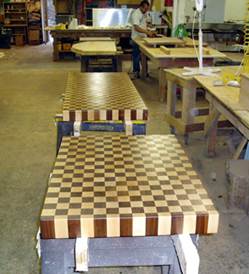
grain in each individual strip tends to want to straighten. So, when looking at the end grains,
they should alternate in direction (see below).

- A
laminated panel has to go through the truing process to square off all
the surfaces. Therefore, it is
important to keep the maximum thickness possible for your strips (as you
will lose some thickness after lamination).
- Lamination
can be done several times to come up with neat designs.
STEPS TO LAMINATION
- Create
all of the strips. They should
all be jointed, planed, ripped and cut to length.
- Choose
the nicest side of each strip and have them all face up.
- Check
the end grain. You might have to
flip or reorder your boards so that the end grains alternate.
- Also
check to make sure that there is no big gab at any location. If there is, you might have to reorder
the boards or perhaps re-joint the mating surfaces.
- Label
you pieces so that you know which one goes where.
- Get
two clamps and place your strips inside them. The clamps should be near the end of
the boards. You need to include
scrap wood spacers between the clamps and your panel to protect your
panel.
- Add
glue to all surfaces that will contact each other. Spread the glue everywhere on the
surface (using your finger).
- Tighten
the clamps just a little bit on your boards. Do not tighten too much yet as your
board might pop out.
- Get
a third clamp. Sit it on top of
your panel. Tighten it. It should stop the panel from popping
out.
- Tighten
all three clamps as much as you can.
- Scrape
excess glue off. If possible,
avoid spreading glue over the wood’s surface. A slightly damp paper towel removes
glue.
- Let
panel dry overnight.
- Remove
panel from clamp.
- Use
scraper to remove large nuggets of glue.
- Return
to the truing process (jointer, planer, table saw, mitre
saw) to square off your panel.
|